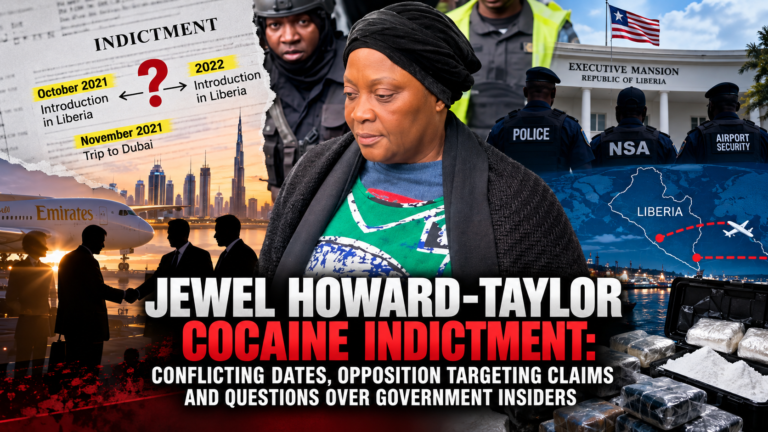

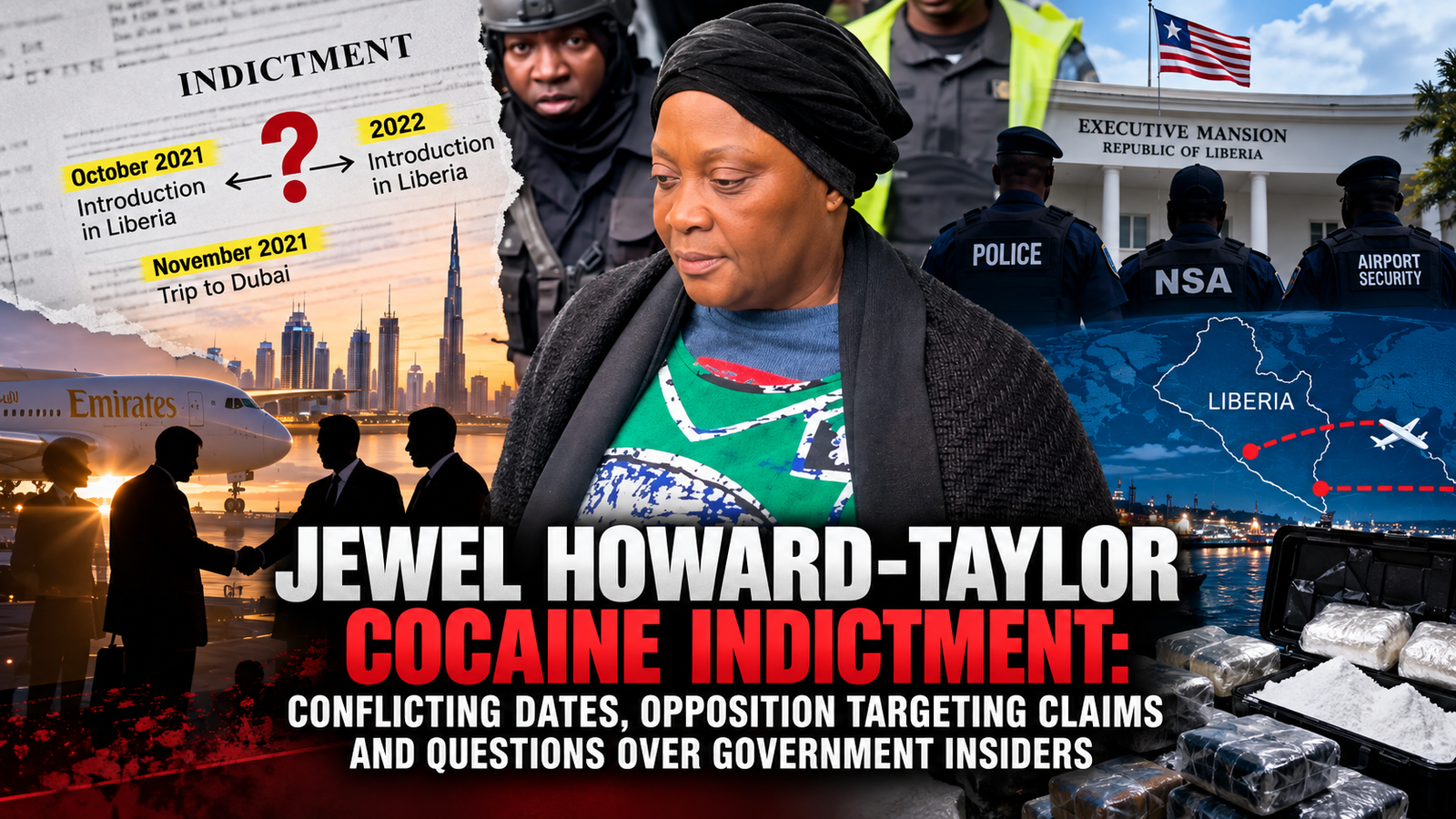
MONROVIA, LIBERIA: The indictment of former Vice President Jewel Howard-Taylor in connection with a multimillion-dollar international cocaine trafficking operation has opened a contentious chapter in Liberia’s fight against organized crime, raising questions that extend beyond the guilt or innocence of one prominent opposition figure.
At the center of the controversy is a 57-page indictment filed before Criminal Court “A” in Montserrado County, which accuses Howard-Taylor and several other defendants of participating in an international cocaine trafficking network allegedly operating through Liberia since 2021.
But a review of the court document by BanaBridge News reveals conflicting dates surrounding Howard-Taylor’s alleged recruitment into the criminal enterprise, inconsistencies in the chronology of her meetings with suspected traffickers, and questions about the alleged financial transactions used to connect her to the operation.
The discrepancies come against the backdrop of documented allegations involving serving and former government security officials, some of whom occupied sensitive positions during the administration of President Joseph Nyuma Boakai.
The central issue is no longer simply whether Howard-Taylor can answer the allegations against her. It is also whether the Liberian government is prepared to subject everyone implicated in the scandal, regardless of political affiliation or official position, to the same standard of investigation and prosecution.
An indictment struggling with its own timeline
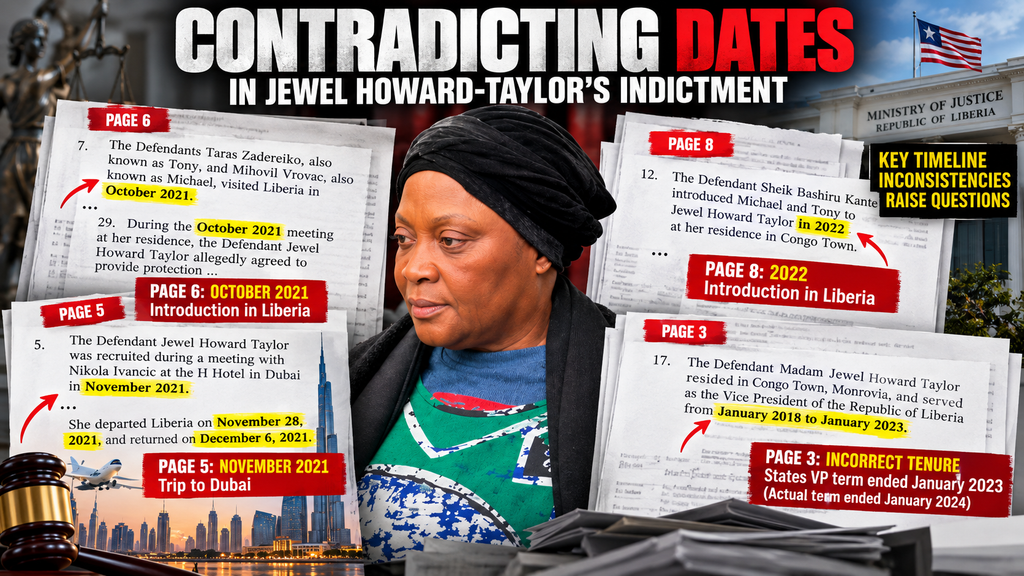
According to paragraph seven on page six of the indictment, alleged traffickers Taras Zadereiko, commonly called Tony, and Mihovil Vrovac, known as Michael, visited Liberia in October 2021.
During that visit, the indictment claims, businessman Sheik Bashiru Kante introduced the two men to Howard-Taylor at her residence in Congo Town.
The document further alleges that the two foreign nationals invited the then-vice president to Dubai to meet Nikola Ivancic, identified by prosecutors as a principal organizer of the cocaine trafficking network.
The indictment provides a specific travel timeline, alleging that Howard-Taylor departed Liberia on November 28, 2021, met Ivancic in Dubai that same month, and returned home on December 6, 2021.
Yet paragraph 12 on page eight presents a materially different account.
That section states that Kante introduced Michael and Tony to Howard-Taylor in 2022 at her residence in Congo Town.
The discrepancy raises an obvious question: If the introduction occurred in 2022, how could the same introduction have led to her November 2021 trip to Dubai?
The prosecution has not reconciled the two dates within the indictment.
The contradiction does not establish that the alleged meeting never occurred. It could result from a drafting mistake, a misdated event or two separate meetings that prosecutors failed to distinguish.
Nevertheless, in a criminal case involving allegations of conspiracy and money laundering, the sequence of events is important. Establishing when a defendant allegedly met other participants, learned of a criminal enterprise and agreed to participate can be central to proving the prosecution’s theory.
There is another factual error.
Paragraph 17 on page three states that Howard-Taylor served as Liberia’s vice president from January 2018 to January 2023. Her tenure actually ended in January 2024, following the transfer of power from former President George Manneh Weah to President Boakai.
While this mistake does not establish a false criminal allegation, it adds to concerns about the accuracy of a document carrying potentially severe consequences for the accused.
Was Howard-Taylor recruited in Liberia or Dubai?
The indictment also leaves uncertainty about the point at which Howard-Taylor allegedly became involved in the trafficking operation.
Paragraph five on page five claims that Ivancic recruited her during a meeting at the H Hotel in Dubai in November 2021, allegedly securing her assistance in providing protection at the highest levels of the Liberian government.
Another section alleges that she had already agreed to provide protection during an earlier meeting at her residence in Liberia.
Both events could have occurred, but the prosecution must distinguish between an initial introduction, a preliminary discussion and an actual agreement to participate in criminal conduct.
The indictment also alleges that Howard-Taylor received financial benefits connected to the network, including assistance to her Starfish Foundation.
These allegations require examination of banking records, transaction dates, communications and the circumstances surrounding the payments.
A donation to a charitable organization, standing alone, is not proof of drug trafficking. Prosecutors would need to establish the criminal connection alleged in their case.
The question is whether the government possesses independently verifiable evidence demonstrating that Howard-Taylor knowingly participated in the illegal enterprise, rather than merely having contact with individuals later accused of trafficking drugs.
The government insiders who cannot be ignored
While attention has focused heavily on Howard-Taylor, the broader investigation has exposed troubling allegations concerning individuals entrusted with protecting Liberia’s national security and transportation infrastructure.
On July 31, 2026, President Boakai ordered the dismissal of several senior officials following findings from narcotics investigations.
Among those dismissed were Mark Egon Kuiah, Deputy Director for Operations at Roberts International Airport; Johnny Bolar Dean, Commissioner of Police for Criminal Investigation, Intelligence and INTERPOL; and Patrick Doe, Deputy Director for Administration at the National Security Agency.
The dismissals were announced by the Executive Mansion as part of the government’s response to the investigations. They do not, by themselves, establish that the officials committed crimes.
The indictment reviewed by BanaBridge News separately names police officers Anthony T. Blaye and Wadell W. Kwarbo, along with security and aviation personnel accused of facilitating aspects of the cocaine operation.
Prosecutors allege that members of the network arranged security escorts, transportation, landing facilities and other logistical support necessary to move cocaine through Liberia.
These allegations point to an important institutional question: How could a trafficking network allegedly move enormous quantities of cocaine through Liberian territory without the assistance, negligence or failure of individuals responsible for national security?
That question becomes particularly relevant because some of the accused officials served in government institutions during the current administration.
Their presence in those institutions does not prove that President Boakai or his political leadership knew about, authorized or benefited from the alleged trafficking operation.
It does, however, make an independent examination of institutional accountability essential.
Is the former vice president being made a political scapegoat?
The political implications of Howard-Taylor’s prosecution have not escaped Liberia’s opposition.
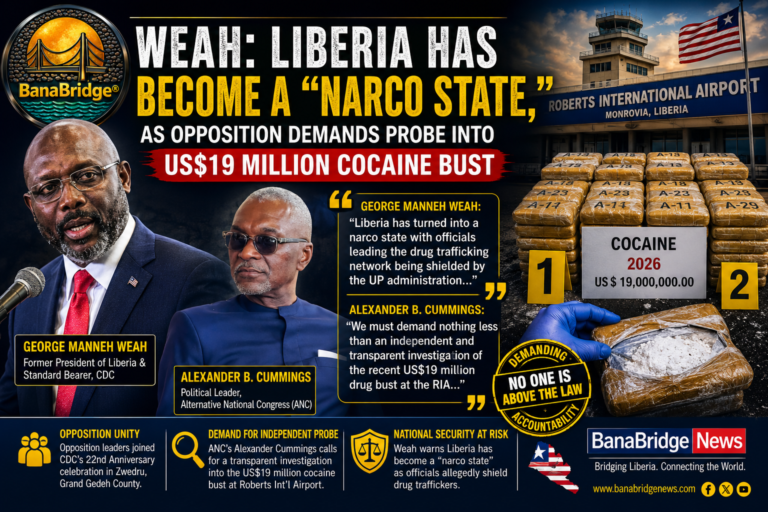
In August, the Alternative National Congress (ANC) expressed concern about what it described as a perception that the government was concentrating on individuals associated with the former ruling Congress for Democratic Change.
The ANC also questioned whether people connected to the current Unity Party administration were receiving equivalent investigative scrutiny.
Those concerns deserve examination, particularly given the number of serving officials identified in the government’s own announcements.
However, the available evidence does not establish that Howard-Taylor was deliberately framed or selected to shield others. Nor does the involvement of officials serving under Boakai establish that the former vice president had no role in the alleged operation.
Both possibilities must be investigated on their own evidence.
The government has taken action against several serving officials, including dismissals and referrals for prosecution. That record must be acknowledged when assessing claims that the investigation exclusively targets opposition figures.
The more difficult question is whether those actions represent the full extent of accountability or only the beginning.
Were senior officials outside the security agencies aware of the alleged activities? Were suspicious financial transactions reported? Did investigators follow every lead involving politically connected individuals? And have all suspects been treated consistently?
These questions cannot be answered through political declarations alone.
The government’s position
Justice Minister and Attorney General N. Oswald Tweh has rejected the suggestion that political affiliation should influence the investigation.
In an official statement announcing the charges against Howard-Taylor, the Ministry of Justice pledged:
“There will be no selective justice, political protection, sacred cows or compromise with organized criminality.”
The government said the investigation would pursue individuals involved in financing, transporting, protecting and organizing the alleged narcotics network, regardless of their positions.
It also emphasized that the charges remain accusations and that defendants are presumed innocent until proven guilty.
The administration’s public position is therefore that the investigation is a legitimate criminal prosecution rather than an attack on political opponents.
Whether that commitment is fulfilled will depend on the evidence presented in court and the consistency with which investigators pursue all implicated individuals.
A trafficking network allegedly operating across two administrations
Another significant detail emerges from the government’s own description of the alleged criminal network.
In August, Information Minister Jerolinmek M. Piah stated that investigators had uncovered indications of a sophisticated trafficking network operating in Liberia for more than six years.
If substantiated, that account would place the network’s activities across both the Weah and Boakai administrations.
It would also challenge any attempt to portray the trafficking problem as belonging exclusively to one political administration.
The indictment alleges that the enterprise continued into 2026, more than two years after Howard-Taylor left office.
Prosecutors must therefore explain how the network allegedly maintained access to security personnel, transportation facilities and other logistical resources after the change of government.
The existence of an alleged criminal network spanning successive administrations does not automatically implicate the political leadership of either government.
It does, however, make a comprehensive investigation necessary.
What must be established in court
The allegations against Howard-Taylor are serious. They involve an alleged international trafficking network, financial arrangements and claims that her former position was used to provide protection for criminal activities.
The prosecution is entitled to present its evidence, call witnesses and seek a conviction if it can establish the charges beyond a reasonable doubt.
Howard-Taylor is equally entitled to challenge the allegations, examine the prosecution’s documents, question witnesses and contest the authenticity or interpretation of financial and electronic evidence.
The conflicting dates in the indictment provide legitimate grounds for questioning the prosecution’s chronology. They do not, without more, establish that investigators invented the allegations.
For a case of this magnitude, prosecutors should be able to produce independently verifiable records, particularly concerning the alleged Dubai meetings, international travel, financial transactions and communications.
The government should also provide a clear accounting of how it has investigated the serving officials allegedly involved in the operation, including the status of criminal proceedings against them.
Liberia deserves the whole truth
The cocaine scandal has exposed serious vulnerabilities in Liberia’s security and law-enforcement institutions.
It has also created a test of the country’s commitment to equal justice.
If Howard-Taylor knowingly participated in a trafficking conspiracy, her former position should not protect her from accountability.
If investigators have wrongly implicated her, the justice system must provide a meaningful opportunity to expose those errors.
And if serving officials facilitated the movement of cocaine through Liberia, their political connections or institutional positions must not shield them from prosecution.
The inconsistencies identified in the indictment require answers. So do the allegations involving officials who served during the current administration.
The question is not whether an opposition politician should be prosecuted. It is whether the same evidentiary standards, investigative rigor and legal protections are being applied to everyone.
Until the evidence is fully examined in court, claims that Howard-Taylor is being framed remain unproven, just as the criminal allegations against her remain unproven.
Liberia’s fight against drug trafficking will ultimately be judged not by the prominence of those arrested, but by whether the investigation exposes the full network and holds every culpable participant accountable.
About The Author