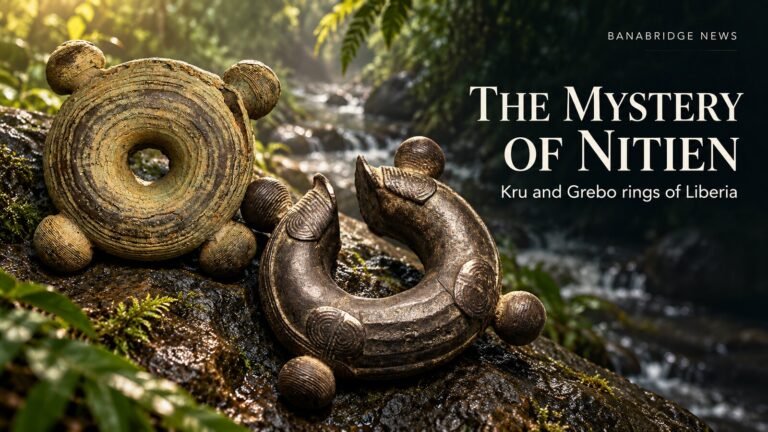

A heavy metal ring with four projecting knobs can look like an oversized bracelet. Yet rings associated with the Kru and Grebo peoples of southeastern Liberia carry meanings that go well beyond their appearance. Museum catalogues have classified them as currency, while other records describe objects once regarded as living beings connected to water and the protection of a community. 1,2,4
Known in published accounts as nitien, with variations in spelling and local names, these rings present an unfinished chapter of Liberian cultural history. Their physical survival allows researchers to examine the objects. Establishing who made the earliest examples, when they were made and how their uses varied is more difficult. 4
Surviving examples include closed rings with a central opening and open forms resembling anklets. Four projecting knobs often distinguish them, although their size and construction vary. These differences matter when considering whether an object was worn, kept in a shrine or used in another way. 3
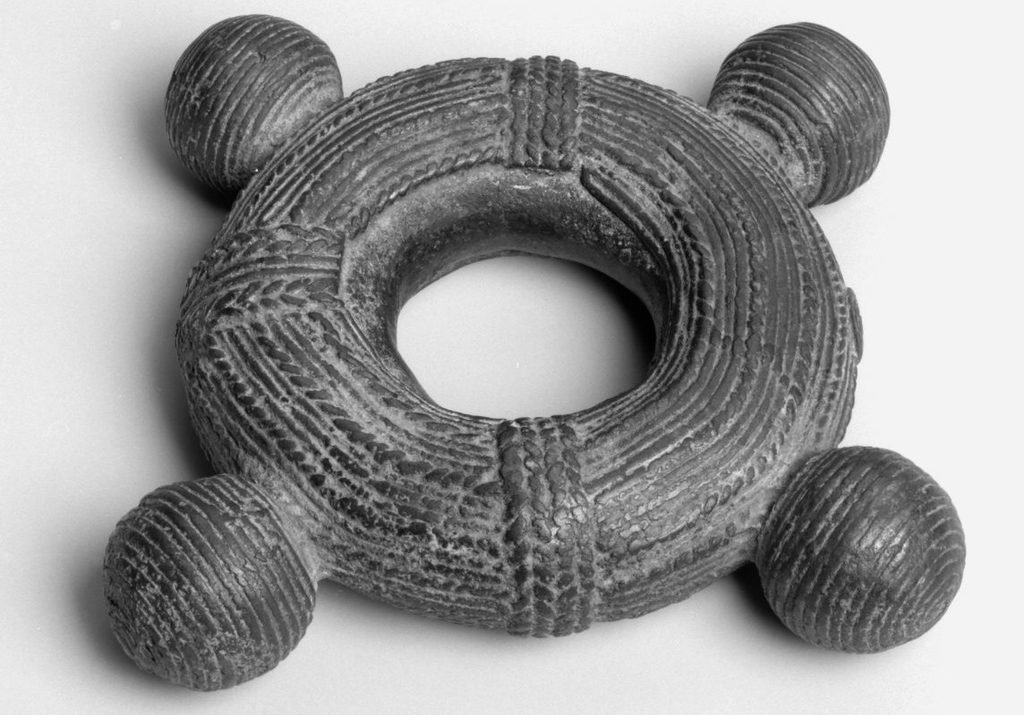
The Brooklyn Museum in New York holds examples catalogued as Currency (Nitien), attributed to Kru or Grebo makers in Liberia and dated to the 19th century or earlier. The open example photographed with this article is made of copper alloy and measures about 18.4 centimetres across its longest dimension. Its accession number is 1998.127.8. 1
Some examples were much larger. A ring featured on the cover of the 1970–1971 Liberian Studies Journal was recorded as weighing 27 pounds, about 12 kilograms. Collected near Barclayville in 1965, it was described in the cover caption as having an unknown use. That description records a gap in the collector’s documentation; it does not establish that people in the community had no knowledge of it. 4
The Smithsonian’s National Museum of African Art offers a different emphasis from the currency label. Its record for a four-knobbed ring identifies it as a ritual object and describes a tien as a water spirit. The accompanying interpretation says such objects were considered living beings associated with peace, fertility and health, and could serve as village guardians when brought from streams. 2
These are accounts of religious belief and cultural practice. They explain the significance people attached to the objects without establishing that metal rings could move, heal illness or exercise supernatural powers. They also should not be read as a statement of what every Kru or Grebo person believes today.
In his 2006 Liberian Studies Journal article, “Nitien: The Curious Case of Kru Money,” Scott Shepperd argued for understanding the rings as sacred objects of power. “Medicine” in this context refers to spiritual protection and ritual efficacy. 3
The economic evidence needs care. Shepperd’s review records earlier reports of rings being used occasionally to purchase cattle or contribute to bridewealth, the transfers associated with marriage. He nevertheless found little documentary support for treating them as ordinary circulating money. Occasional exchange and sacred significance could coexist; neither a museum label nor a single reported use settles the function of every specimen. 3
The literature also connects some rings with the Bodio, a ritual priest associated with community welfare. Shepperd considered whether particular examples represented the priest’s regalia or medicines belonging to a town or lineage. He explicitly left those identifications unresolved. It would overstate his findings to describe every nitien as a priest’s anklet. 3
An archival photograph adds another piece of evidence. In a January 2016 account, researcher Fred P. M. van der Kraaij credited collector Mark Clayton with noticing a knobbed ring on the ground in an uncropped photograph held by Harvard’s Peabody Museum. A cropped version had appeared in the 1947 publication Tribes of the Liberian Hinterland. Van der Kraaij described the setting as a medicine man’s hut. 5
That reported setting supports a ritual interpretation of the photographed object. It cannot, by itself, establish the original purpose of all similar rings or exclude their use in exchanges. The photograph is valuable because it places an object in a setting, something an isolated museum photograph cannot do.
Dates require similar precision. A collection date tells us when an object entered a recorded collection, not when a metalworker cast it. The Brooklyn Museum’s broad dating leaves considerable uncertainty. Descriptions such as “ancient,” or claims that every example is several centuries old, need evidence tied to individual objects. 1
A fuller history would need to connect surviving rings with reliable accounts of where they were found, how they were acquired and who held them. Comparisons of their materials and construction could then be considered alongside community histories. A ring without that information may remain difficult to interpret, however carefully it is displayed.
For Liberian readers, the unanswered questions create a reason to seek local knowledge. Published catalogues are useful starting points, but they cannot substitute for the testimony of people whose families and communities have associations with these objects. An incomplete written record should not be mistaken for an absence of history.
Further reporting could begin with elders, traditional custodians and Liberian researchers willing to discuss what they know. What names are used in particular languages? Are there accounts of a specific ring, its keeper or its movement between communities? Recording who supplied an account, where it comes from and what may be shared publicly would make that testimony more useful to future readers.
Schools and museums could place those accounts beside photographs and collection records, allowing students to see how historical knowledge is assembled and where it remains uncertain. For the nitien, the next useful discovery may be a documented family account that gives a surviving ring its local name and history.
Sources and photo credit
1. Brooklyn Museum. Currency (Nitien), objects 159437 and 164597; accession numbers 1998.127.8 and 2004.52.14. Collection records. Open ring record · Closed ring record
2. Smithsonian National Museum of African Art. Ritual object, accession 2015-4-3. Collection label and object description. Smithsonian record
3. Scott Shepperd. “Nitien: The Curious Case of Kru Money.” Liberian Studies Journal 31, no. 2 (2006), pp. 50–85. Relevant discussion at pp. 51, 54–55, 67 and 69. Journal PDF
4. Fred P. M. van der Kraaij. “The mystery of the Kru or Grebo rings – Part I.” Liberia Past and Present, 7 April 2014, updated 25 January 2016. Read article
5. Fred P. M. van der Kraaij. “The mystery of the Kru or Grebo rings – an important discovery.” Liberia Past and Present, 25 January 2016. Read article
Photo source: Brooklyn Museum photograph 1998.127.8_transpc003.jpg, reproduced through the corresponding Wikimedia Commons file record under Creative Commons Attribution 3.0. Image and license record
About The Author