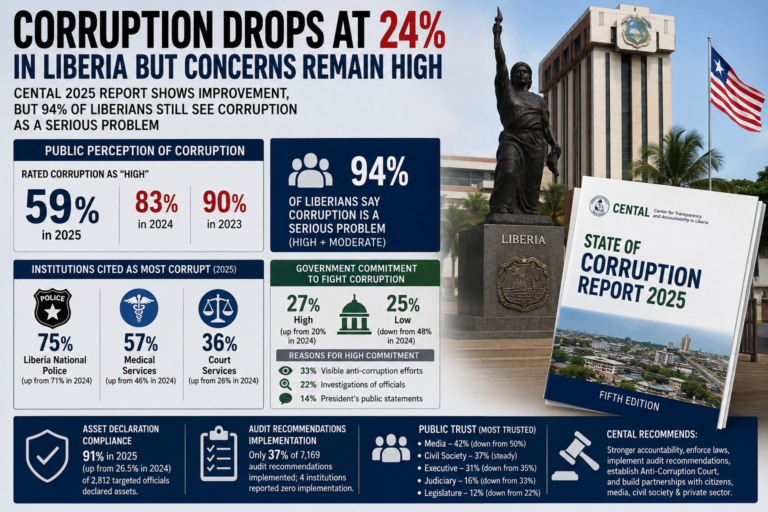


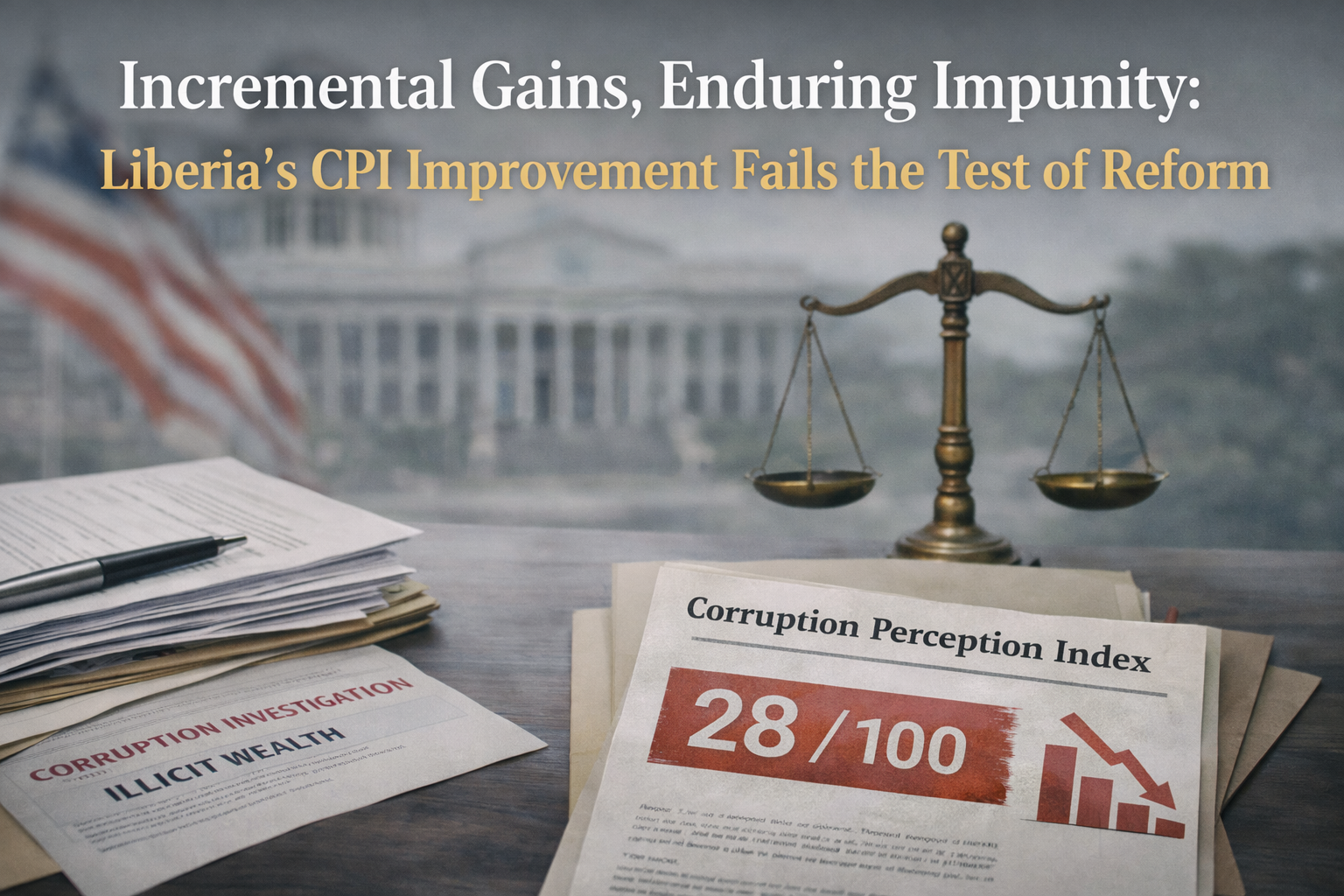
Liberia’s latest showing on the Corruption Perceptions Index (CPI) offers little more than statistical relief. In the 2025 CPI released by Transparency International, Liberia edged up by a single point to 28 out of 100, ranking 136th of 182 countries. While government allies may frame this as progress, the underlying data and long-term trend suggest a corruption fight that remains hesitant, inconsistent, and far from transformative.
The findings were released on Tuesday, February 10, 2026, by Center for Transparency and Accountability in Liberia (CENTAL) through its Executive Director, Anderson Maimen. His message was blunt: marginal gains cannot mask systemic failure. Liberia, he warned, still lacks the decisive reforms required to reverse years of institutional decay.
A Region Stuck, a Country Sliding
Liberia’s score remains below the Sub-Saharan Africa average of 32, the lowest-performing region globally. Even more troubling is the historical context: despite this year’s uptick, Liberia has lost 13 points since 2012, placing it among the world’s worst long-term decliners. By comparison, countries such as Seychelles, Cabo Verde, Botswana, and Rwanda continue to outperform the region, while Côte d’Ivoire and Tanzania have posted measurable improvements. Liberia’s movement, by contrast, barely registers.
Globally, the CPI paints a bleak picture. The average score has fallen to 42, its lowest level in more than a decade, underscoring a worldwide erosion of accountability. Western Europe and the European Union still lead with an average of 64, while Sub-Saharan Africa remains anchored at the bottom, an indictment of governments that promise reform but tolerate impunity.
Measuring Perception, Exposing Reality
CENTAL emphasized that the CPI draws on 13 independent data sources, reflecting assessments by experts and business executives. These sources evaluate bribery, diversion of public funds, abuse of office, procurement fraud, state capture, and nepotism, precisely the practices that continue to dominate Liberia’s governance discourse.
While acknowledging the one-point increase under President Joseph N. Boakai and Vice President Jeremiah Koung, Maimen cautioned against celebration. The pace of reform, he argued, is slowing rather than accelerating. After a two-point rise in 2024, the reduced gain in 2025 suggests waning momentum at a time when bold action is required.
Institutions Weak, Impunity Strong
CENTAL’s critique goes beyond numbers. Public integrity institutions remain underfunded. Asset declaration regimes have yet to produce convincing deterrence. Several former officials sanctioned for corruption, or credibly accused of amassing illicit wealth, have not faced thorough investigation or prosecution. The recent arbitrary appointment at the Independent National Commission on Human Rights, bypassing a transparent and competitive process, further undermines claims of renewed respect for the rule of law.
According to CENTAL, the CPI also assesses whether governments can enforce integrity mechanisms, protect whistleblowers and journalists, guarantee access to information, and ensure the independence of anti-graft bodies. On these measures, Liberia continues to underperform.
Recommendations Recycled, Action Deferred
The watchdog reiterated long-standing prescriptions: establish a specialized anti-corruption court, enforce transparency in state-owned enterprises, strengthen legislative oversight, and adequately finance anti-graft institutions, while holding them to measurable performance standards. These recommendations are not new; what remains absent is political urgency.
Maimen stressed that Liberia’s leadership, President Joseph N. Boakai, Speaker Richard N. Koon, Senate Pro-Tempore Nyonblee Karngar Lawrence, and Chief Justice Yamie Q. Gbeisay, bear collective responsibility for steering the anti-corruption agenda toward credibility rather than rhetoric.
Between Applause and Accountability
CENTAL commended journalists, activists, and ordinary citizens who have kept corruption in the public spotlight over the past two years. Yet civic pressure alone cannot substitute for state action. A one-point CPI increase may soften headlines, but it does not signal reform. Without decisive prosecution, institutional independence, and an end to selective accountability, Liberia’s corruption fight risks becoming a cycle of modest gains, loud praise, and enduring failure.
In short, Liberia’s CPI score may have inched upward, but the country remains trapped in a pattern where perception improves faster than reality, and promises continue to outpace proof.
About the Author