
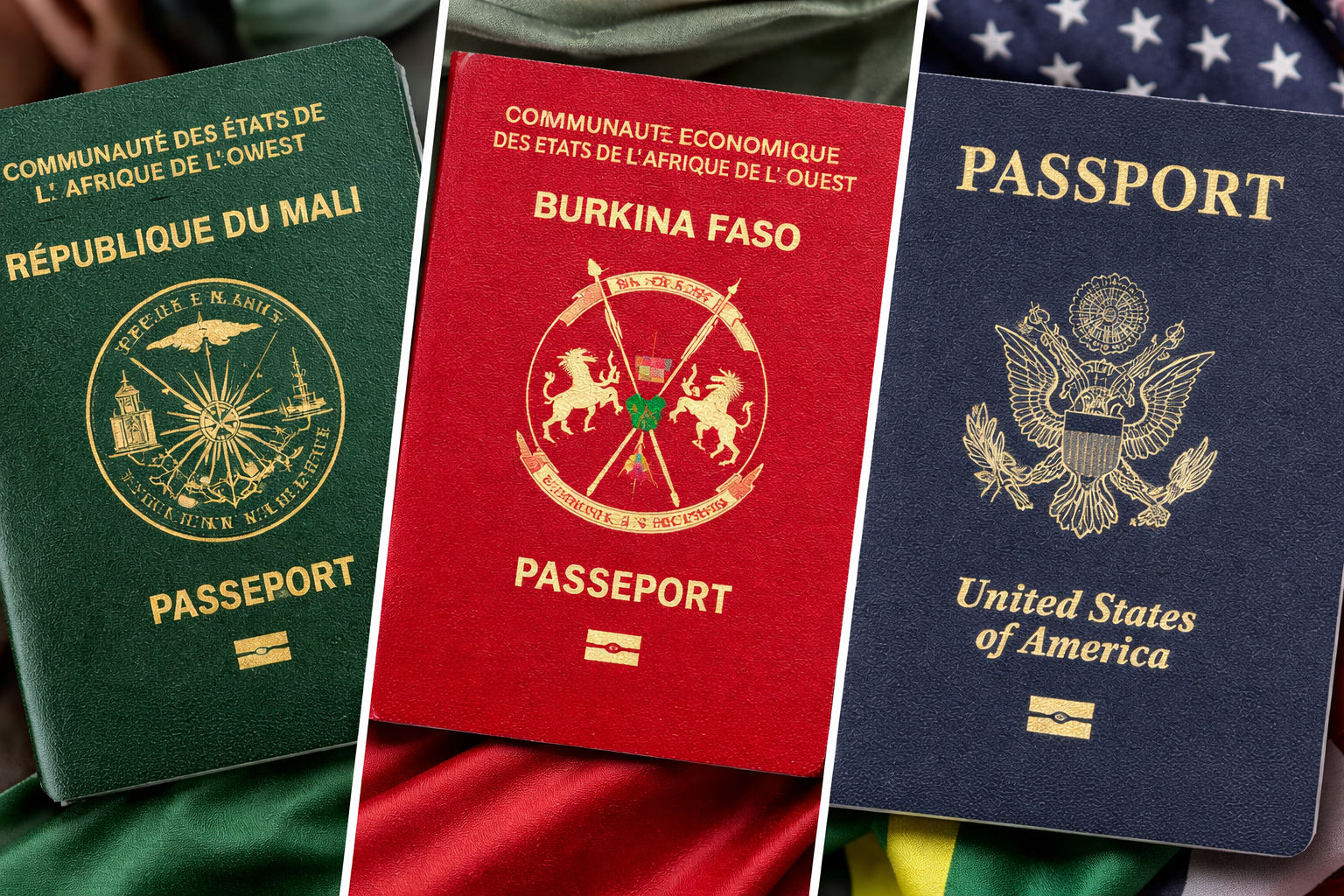
BAMAKO / OUAGADOUGOU: Mali and Burkina Faso have announced a reciprocal travel ban on United States passport holders, escalating diplomatic tensions following Washington’s recent decision to restrict entry for citizens of the two West African nations.
The move, confirmed by officials in both countries, is being framed as a response to what they describe as discriminatory travel policies by the United States. While details remain fluid, the decision has immediate consequences for thousands of people, particularly members of the diaspora who hold only U.S. passports but still consider Mali or Burkina Faso home.
A Diplomatic Response Rooted in Reciprocity
Officials in Bamako and Ouagadougou say the decision is grounded in reciprocity, a principle commonly used in international relations. Simply put, if their citizens face barriers entering the United States, American citizens should expect the same treatment when attempting to enter their countries.
While the announcement did not spell out enforcement mechanisms in full detail, the message was clear: U.S. passport holders are no longer guaranteed entry into Mali or Burkina Faso.
What This Means for Citizens Holding Only a U.S. Passport
For many in the diaspora, this is where the impact becomes deeply personal.
Citizens of Malian or Burkinabè origin who now hold only U.S. citizenship may find themselves unable to return home, even for family emergencies, funerals, business obligations, or cultural events. Entry decisions will now be based strictly on passport nationality, not ethnic origin, family ties, or place of birth.
This means that even individuals born in Mali or Burkina Faso, but who later naturalized as U.S. citizens and no longer hold national passports, could be denied entry at the border.
Airlines are also expected to enforce the restriction before boarding, which could result in travelers being turned away before even leaving the United States.

Dual Nationals May Face a Narrow Path, But Uncertainty Remains
For individuals holding dual citizenship, the situation is more complex. In some cases, travelers may still be permitted to enter if they present a valid Malian or Burkinabè passport instead of a U.S. one. However, neither government has yet issued formal guidance clarifying how dual nationals will be processed.
This uncertainty has created anxiety among diaspora families, many of whom travel frequently for caregiving, investment, and community obligations. Immigration experts caution that travelers should not assume exemptions exist until official guidelines are released.
Until then, even dual nationals are being urged to seek clarification directly from embassies or consular offices before making travel plans.
What This Means in Practical Terms
For now, the reality on the ground is stark:
- U.S. passport holders may be denied entry, regardless of personal or family ties.
- Visa issuance may be suspended or significantly restricted.
- Airlines may refuse boarding to travelers whose destination is Mali or Burkina Faso.
- Transit through these countries may also beaffected, even for passengers not exiting the airport.
The move underscores how quickly geopolitical decisions can disrupt ordinary lives, particularly for Africans in the diaspora who often straddle two worlds.
A Moment of Reflection for the Region
Beyond diplomacy, this decision raises broader questions about sovereignty, global mobility, and the unequal power dynamics that shape international travel. For many West Africans, the restrictions feel less like policy and more like a reminder of how fragile mobility can be when politics intervene.
As the situation evolves, both governments have left the door open for dialogue. Whether that dialogue leads to eased restrictions or prolonged standoffs remains to be seen.
For now, travelers are advised to remain cautious, stay informed through official diplomatic channels, and delay non-essential travel until clearer guidance emerges.
Editor’s Note:
BanaBridge News will continue to monitor developments surrounding this issue and provide updates as official guidance becomes available from Malian, Burkinabè, and U.S. authorities.
About the Author