
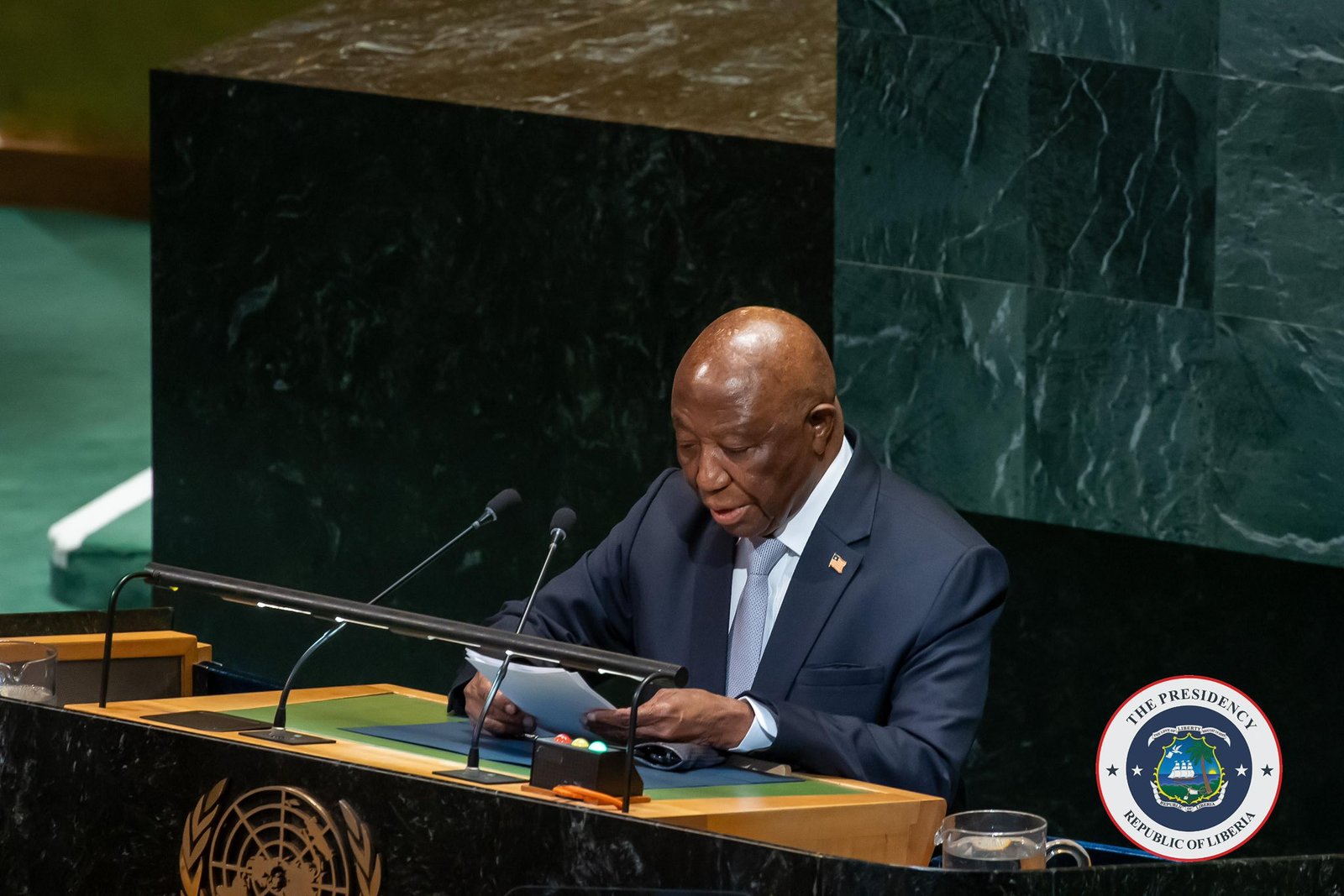
At the Fourth World Conference on Women in New York, Liberian President Joseph N. Boakai announced an ambitious $8.3 billion plan over five years to advance gender equality, youth empowerment, education, health care, and social development. While the pledge briefly raise brows at international stage; and even saw his microphone cut off after he apparently exceeding the allotted speaking time; it raises serious concerns at home, where the scale of the commitment stands in sharp contrast to Liberia’s limited fiscal capacity.
The Math Doesn’t Add Up
Liberia’s annual national budget has never crossed $1 billion. Even with optimistic projections, the cumulative budget over the next five years would fall short of Boakai’s pledged $8.3 billion by billions of dollars. Analysts argue that unless Liberia suddenly experiences a massive resource windfall, unprecedented foreign aid inflows, or extraordinary debt financing, such a promise is economically implausible.
The President’s speech failed to outline where these funds would come from, how they would be allocated, or what accountability mechanisms would prevent misuse in a country long plagued by corruption. Without a financing plan, the $8.3 billion figure risks being dismissed as yet another ambitious but hollow political pronouncement.
Unity Party’s Familiar Pattern of Rhetoric
Critics argue that the Unity Party, both in opposition and in power, has built a reputation on grandiose pledges unanchored in fiscal reality. During the Weah administration, the Unity Party frequently lambasted similar sweeping promises as deceptive rhetoric. Yet now in power, Boakai’s administration appears to be employing the same tactics projecting unattainable commitments to secure credibility at home and abroad.
This is not the first time Liberians have heard such lofty figures. From roads to agriculture to energy, successive Unity Party governments have historically pledged billions in investment plans that never materialized, leaving behind public frustration and deepened distrust in governance.
Taking Political Spin to the World Stage
Perhaps most concerning is the internationalization of this political habit. By making such exaggerated commitments at a global forum, Liberia risks not only domestic disillusionment but also damage to its credibility abroad. Development partners, international financial institutions, and civil society organizations often take note of these commitments. If they are not backed by feasible strategies, Liberia could be viewed as overpromising and underdelivering a dangerous image for a fragile economy heavily dependent on aid.
The Need for Realism
What Liberia needs at this juncture is not more political theater but measured, credible, and transparent planning. Instead of staking out astronomical numbers, the government could strengthen accountability in existing projects such as the Liberia Women Empowerment Project and REALISE Project, which have already reached thousands of Liberians on modest budgets.
True empowerment for women and youth will not come from headline-grabbing pledges but from practical, incremental reforms backed by realistic fiscal strategies.
In conclusion; President Boakai’s speech, though inspirational in tone, highlights the enduring problem of Liberian politics being dominated by rhetoric rather than results. The $8.3 billion pledge may play well in New York, but back home in Monrovia, where citizens know the weight of an overstretched budget, it sounds more like wishful thinking dressed as policy.
Liberians are once again left to wonder: will the Unity Party break free from the cycle of lies and lofty promises, or has it simply repackaged old tactics for a global audience?
About the Author