
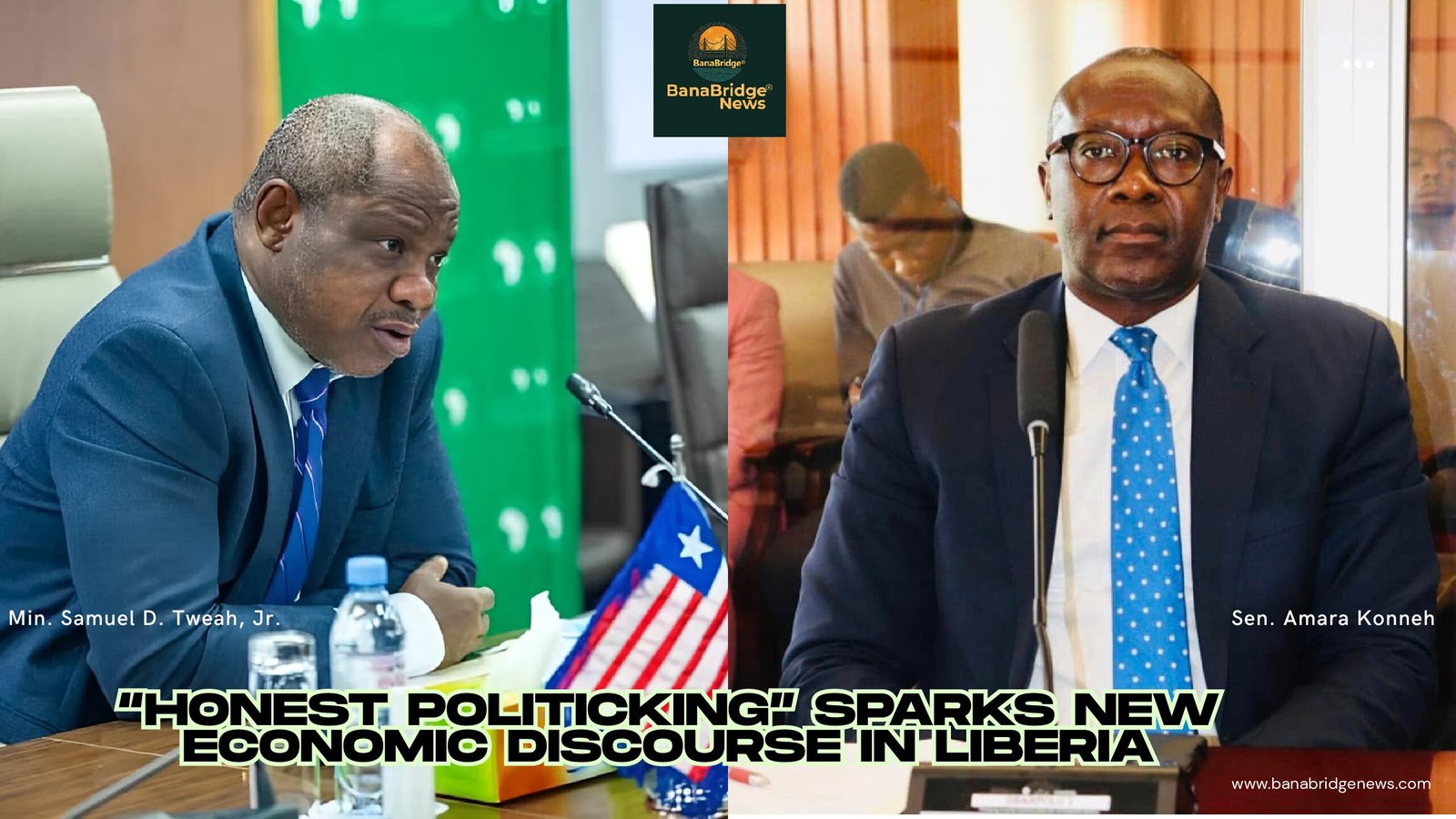
Monrovia, Liberia, July 20, 2025: In a rare display of bipartisan civility and economic candor, two of Liberia’s top political and economic minds, former Finance Minister Samuel D. Tweah Jr. and Gbarpolu Senator Amara Konneh, have sparked a public conversation on “honest politicking” and the country’s macroeconomic trajectory.
At the heart of their exchange is a call to rise above party lines and allow facts, not sentiment; to shape Liberia’s national discourse.
Tweah, who served as Minister of Finance under the George Weah-led CDC administration, publicly praised Senator Konneh for what he described as “independent thinking, bravery and honesty” qualities he said are sorely missing in Liberian politics. “Senator Konneh has stepped up as a leader in this new field of honest politicking,” Tweah stated on Facebook. “Because most politicians do not understand macroeconomic numbers, they do not like to quote them, so our politics is riddled with lies.”
The former finance minister defended the macroeconomic record of the CDC administration, stating that poverty declined, inflation dropped, and net international reserves increased under their watch. He cited recent LISGIS data showing that consumer prices are now 12.48% higher under the Unity Party (UP) government than during the CDC’s final year, pointing to what he believes is a clear erosion in purchasing power.
Konneh, a former Minister of Finance himself under the Ellen Johnson Sirleaf administration and now a Unity Party senator, had earlier criticized both his own allies in the UP and former colleagues in the CDC for politicizing economic data. “We didn’t lie to voters; we pointed out facts,” Konneh wrote. “But no one can intellectualize hardship—not even Adam Smith or Karl Marx.”
In a tone that diverged from the usual political combativeness, Konneh admitted that the economic recovery that began under CDC in 2022 extended into 2023, but failed to translate into tangible benefits for ordinary Liberians. “The CDC overlooked living standards,” Konneh noted. “This is why voters, myself included rejected them.”
Rather than deny the previous administration’s efforts, Konneh emphasized the need to build on them. “Our government is working, but we need to boost economic growth to reach double digits,” he said, warning that the current projected rate of 5.3% isn’t enough to keep pace with Liberia’s rapidly growing labor force.
A New Political Ethic?
What sets this exchange apart in Liberia’s often toxic political climate is the mutual acknowledgment of inconvenient truths and a shared desire for progress. For observers, this could mark a turning point.
“This is a breath of fresh air,” said Elijah Weah, an economic analyst and contributor to the West African Economic Review. “For once, we’re seeing leaders agree on the data and disagree constructively on how to move forward. Liberia has long needed a politics that’s grounded in numbers and not narratives.”
Indeed, Liberia’s economy faces complex headwinds: high youth unemployment, limited private-sector growth, rising public debt, and inflationary pressures that continue to erode real incomes. According to the World Bank, Liberia’s GDP growth averaged only 3.7% over the past five years, well below the regional average and insufficient to lift significant numbers out of poverty.
Konneh’s critique underscores this concern: “Nearly 80,000 young people enter the labor force every year. If we don’t scale up job creation and economic opportunities, frustrations will grow.”
Charting the Path Forward
Tweah, in his remarks, highlighted unfinished CDC-led projects, including the construction of 87 public schools funded by the World Bank; and urged the Unity Party to complete them while shifting focus to improving education quality. “This is how the CDC-UP governance alternation can move Liberia forward,” he said.
Konneh welcomed such reflections, noting that political maturity lies in acknowledging both progress and shortcomings. “We fought for a better Liberia,” he wrote. “Staying silent while we make mistakes feels unpatriotic.”
In conclusion, as Liberia inches toward middle-income status, these public exchanges between two experienced policymakers could serve as a blueprint for post-partisan governance. The key lesson? Sound policy requires sound data; and the humility to listen across the aisle.
If this spirit of “honest politicking” continues, Liberia may finally see the emergence of a political culture that places country above party, and evidence above emotion.
About the Author